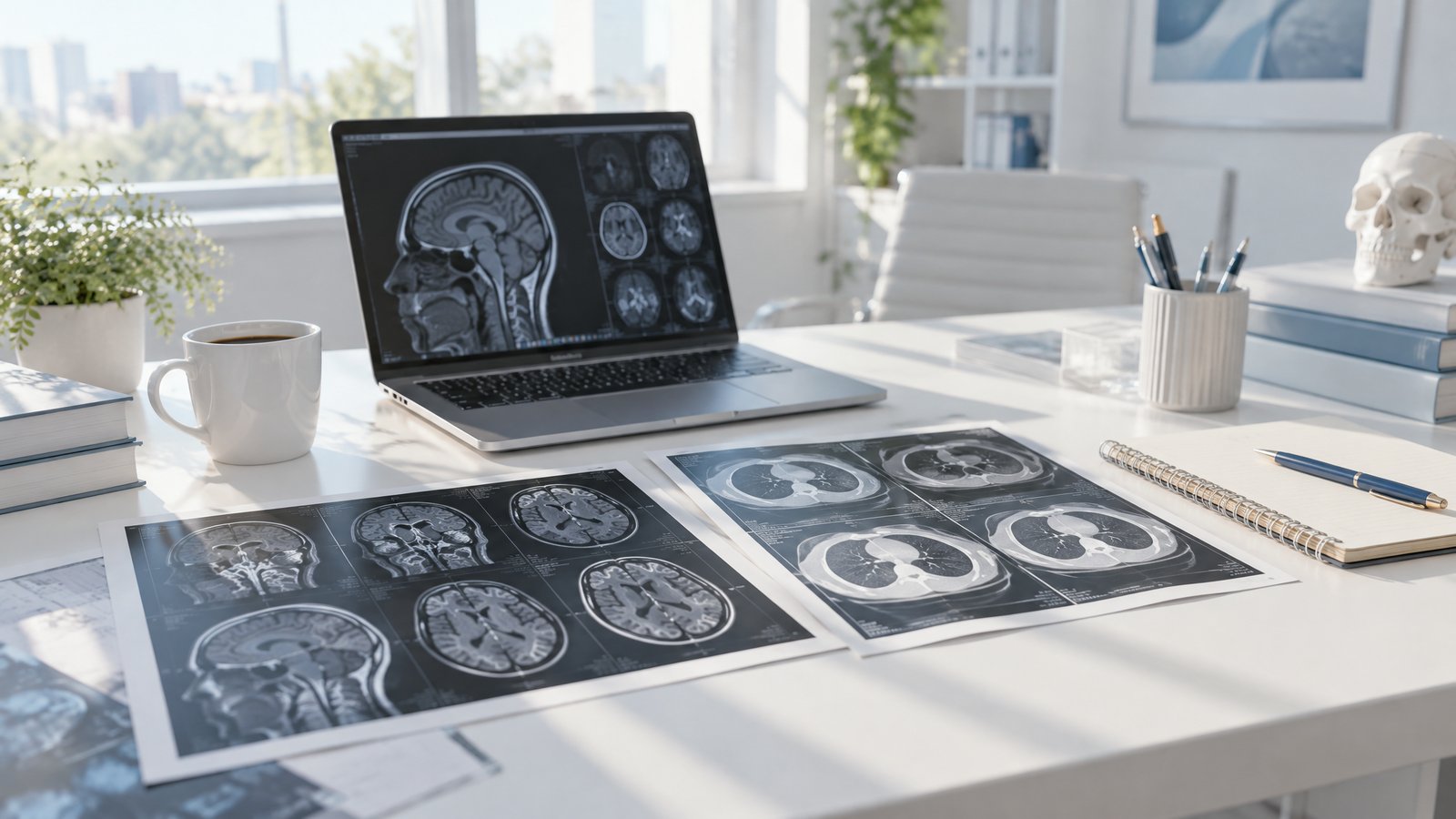
When I first watched a neural network learn to recognize objects in photographs with near-human accuracy, my first thought wasn't about cats or cars. It was about the radiology reading room — dimly lit, quiet, and filled with specialists reviewing image after image, hour after hour.
Medical imaging is one of the richest sources of diagnostic information we have. A single CT or MRI study can contain hundreds of slices of detailed anatomy. Yet the earliest signs of disease — a few-millimeter nodule, a faint change in tissue texture — can occupy just a handful of pixels. Finding them depends on a human being who may be on their fortieth study of the shift.
The idea
Machine vision doesn't get tired. It looks at the first slice and the thousandth slice with the same attention. Combined with machine learning, it can be trained on thousands of expertly labeled scans to recognize patterns that even experienced readers find difficult. I became convinced that this pairing could become an extraordinary partner for clinicians — not a replacement, but a tireless second set of eyes.
"The goal was never to replace the radiologist. The goal was to make sure the radiologist never misses the one finding that matters."
— Roger DinmarStarting small
Dinmar Labs begins in Baltimore with a deliberately small team: a handful of engineers, data scientists and clinical advisors who share a conviction that early detection changes outcomes. Our first objective is narrow and measurable — build a prototype that can reliably detect small lung nodules on CT scans.
We're starting with three principles that will guide everything we do:
- Clinicians in the loop. Every output must be explainable and reviewable by a physician.
- Rigor over hype. We will validate against real-world data and seek peer review.
- Privacy by design. Patient data will be de-identified and protected at every step.
What's next
Over the coming months we'll share our progress on this blog — the breakthroughs and the setbacks. Thank you for following along. We believe the earliest chapter of every patient's story deserves to be read.
— Roger Dinmar, Founder & CEO